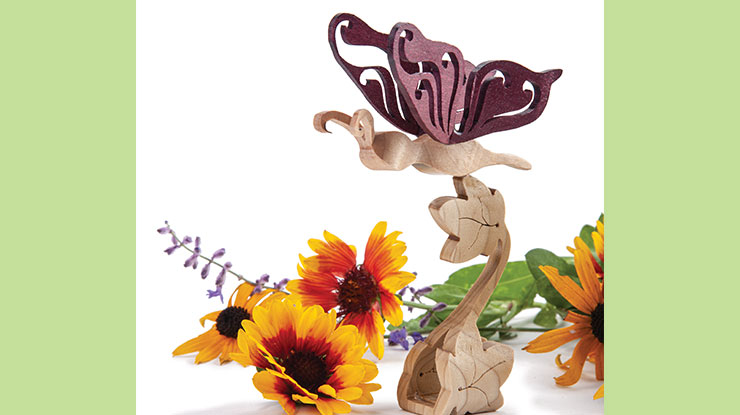
Compound-Cut Butterfly
Watch this colorful pollinator emerge from just three little scraps of wood
By Diana Thompson
Cut by Joe Pascucci
There are few compound-cut subjects more fitting than the butterfly. Think about it. From the outside of the cocoon, it seems like nothing is happening—until the very end, when the elegant insect emerges, defined and complete and (hopefully) in one piece. Precision is key in this project, but once you get the hang of it, you’ll be cranking out enough of these critters to fill an entire butterfly house! Before making your first cut, ensure your compound cuts are accurate in our exclusive technique article.
Cutting and FinishingAttach the body, wing, and leaf patterns to the blanks using spray adhesive, making sure the fold on the dotted line corresponds with a corner. Note: I included two different wing patterns for this project; you can cut one or both. Drill the blade-entry holes on the wing and leaf blanks. Cut the pieces; I used a #5 skip-tooth blade, but you can adjust blade size depending on your wood selection. Carefully cut the side views first—the leaf outline, the notched part of the butterfly body, and the wing shape. For the wings, cut the inner frets before moving on to the perimeter. Once you’ve cut each side view, rotate the blank 90° and wrap it with clear packaging tape to secure the waste wood. Then cut the front views. Remove the pieces from the waste wood. Gently hand-sand with 220-grit sandpaper and buff each piece with a clean, dry cloth to remove excess dust. Finish as desired; I used a few coats of clear semigloss spray lacquer in order to show off the natural colors of the wood. Glue the wings to the notch on the torso and the torso to the top of the leaf. Let dry and display. |
|
Materials • Wood, such as maple, 1-1/2″ (3.8cm) square: body, 3-7/8″ (9.8cm) long • Wood, such as poplar, 1-1/2″ (3.8cm) square: leaf, 3-1/2″ (8.9cm) long • Wood, such as purpleheart, 1-1/2″ (3.8cm) square: wings, 3-1/2″ (8.9cm) long • Spray adhesive • Tape: clear packaging • Sandpaper: 220-grit • Wood glue • Finish: clear semigloss spray lacquer • Cloth rags Tools • Drill with bits: assorted small • Scroll saw blade: #5 skip-tooth |
| About the Author |
| The late Diana Thompson of Theodore, Ala., authored numerous articles and books about compound cutting. For more of her work, visit foxchapelpublishing.com. |
Get the Latest Issue
For more articles like this, subscribe to Scroll Saw Woodworking & Crafts magazine.
Plus! Get digital mini magazines in your e-mail between printed issues.